In my experiencing of building fraud and risk systems , I thought I'd seen every kind of document fraud. Crude Photoshop edits. Recycled templates with mismatched fonts. Paystubs that didn't survive a second look.
Then generative AI happened. And overnight, the game changed completely.
Today, a fraudster with no technical skill can generate a pixel-perfect bank statement, a convincing W-2, or a synthetic driver's license in under sixty seconds. The tools are free, widely available, and improving every month. Meanwhile, most financial institutions are still reviewing documents the same way they did five years ago: manually, slowly, and one at a time.
That gap — between how fast fraud is created and how fast it's detected — is where billions of dollars disappear every year. It's the problem I built Clox AI to solve.
The Numbers Don't Lie: Fraud Is Accelerating
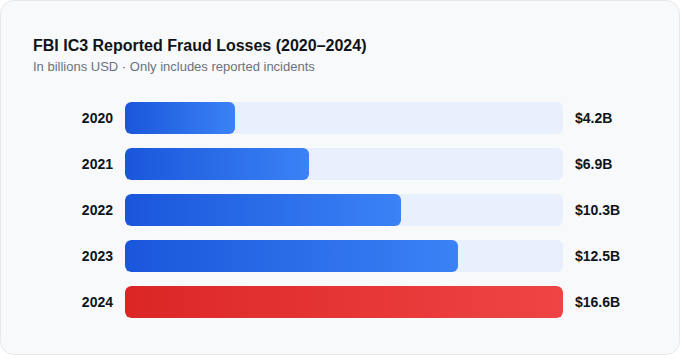
The FBI's Internet Crime Complaint Center reported $16.6 billion in fraud losses in 2024 — a 33% jump from the previous year. Over the past five years, cumulative reported losses crossed $50 billion, and that only accounts for crimes that were actually reported.
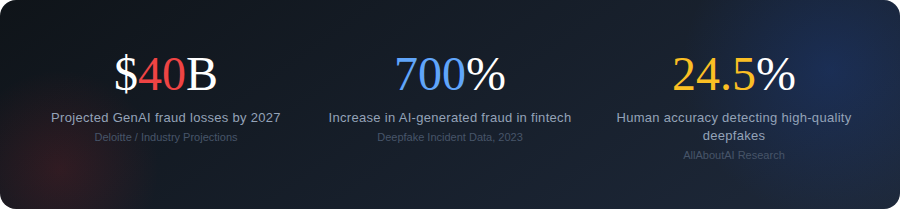
But the raw dollar figures only tell part of the story. The nature of fraud itself is evolving. Deepfake incidents in fintech surged 700% in recent years, and AI-generated document fraud grew 300% since 2022. These aren't amateur attempts — they're coordinated operations using synthetic identities, deepfakes, and AI-generated documents designed specifically to bypass verification systems.
Sophisticated multi-step fraud attacks — schemes involving several coordinated stages — surged 180% year-over-year in 2025. The share of "advanced" fraud attempts jumped from 10% of all fraud in 2024 to 28% in 2025. Fewer attacks, but each one sharper, harder to detect, and far more damaging.
The Generative AI Problem
Here's what keeps me up at night. In 2025, AI-generated fake documents appeared on the fraud landscape for the first time, accounting for 2% of all detected forgeries within just six months of being first observed. That number may sound small. It's not. It represents the beginning of an exponential curve — and projections estimate generative AI could cost banks and their customers up to $40 billion by 2027.
⚠️ The new reality
Fake bank statements account for 59% of all fraudulent documents detected in financial services. Fraudulent document templates increased 50% from 2023 to 2024. A fraudster can now generate a convincing fake document in under 60 seconds — while the average manual review takes 10+ minutes.
The tools to create these fakes are democratized. Fraud-as-a-service platforms package AI capabilities into ready-to-use kits. Social media forums openly sell templates. And autonomous AI fraud agents — systems that can generate synthetic identities, interact with verification systems in real time, and learn from failed attempts — are expected to become mainstream by 2026.
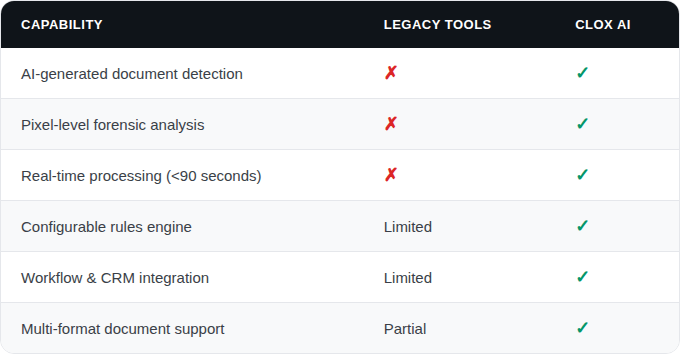
Traditional detection can't keep pace with this. Template matching fails when every document is uniquely generated. OCR-based checks miss pixel-level manipulations. Manual review can't scale when fraud volumes are exploding and each document looks increasingly authentic.
Why "Batch Review" Is a Liability
Most document verification workflows today operate on a batch model: documents come in, sit in a queue, and eventually get reviewed by an analyst — or a basic rules engine — hours or even days later.
This was workable when fraud was crude and infrequent. It's indefensible now.
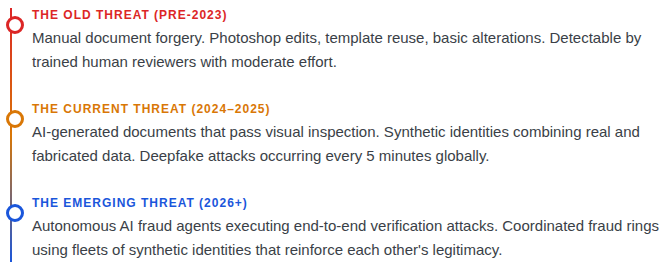
Every hour a fraudulent document sits undetected is an hour it can be used to open accounts, approve loans, or trigger payments. Batch processing doesn't just miss fraud — it gives fraud time to succeed.
What Real-Time Detection Actually Requires
Real-time document fraud detection isn't just "faster OCR." It requires a fundamentally different approach — one that analyzes what the human eye cannot see and connects what isolated reviews cannot link.
At Clox AI, we built our platform around this principle. Here's what our detection pipeline looks like in practice:
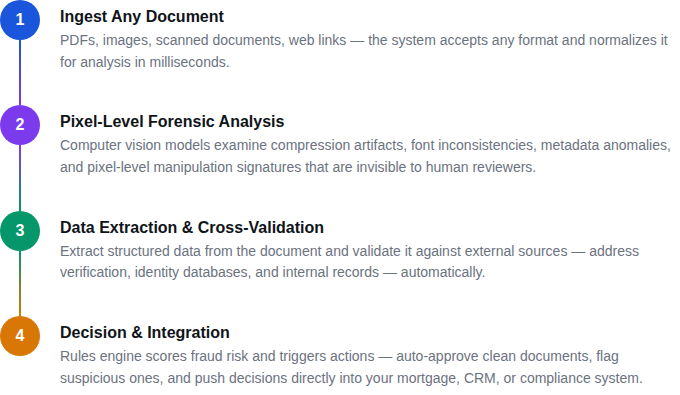
The entire process takes seconds, not minutes. And critically, it catches things that no human reviewer — no matter how experienced — could see: the subtle compression artifacts left by AI image generators, the metadata inconsistencies of a spliced document, and the patterns that reveal coordinated fraud attempts across your portfolio.
Beyond Template Matching: Why Forensics Matters
Most fraud detection tools analyze documents using template matching and data verification. They check if the numbers add up and if the format looks familiar. That was sufficient when forgers were sloppy. It's dangerously inadequate now.
AI-generated documents don't reuse templates — they create new ones every time. The numbers do add up, because the AI is smart enough to make them consistent. The format looks perfect, because it was generated from training data of millions of real documents.
🔍 The forensic difference
Clox AI goes beyond what's visible on the surface. Our pixel-level forensic analysis detects compression artifacts, noise patterns, font rendering inconsistencies, and metadata anomalies that AI generators leave behind — the digital fingerprints that are invisible to the human eye but unmistakable to purpose-built detection models.
This is the capability gap that matters most. Template matching tells you if a document looks wrong. Data verification tells you if the numbers check out. But only forensic analysis tells you if a document is authentic — whether it was created by the institution it claims to be from, or fabricated by an AI model in seconds.
The Detection Gap: Legacy vs. Real-Time
What This Means in Practice
The operational impact of moving from batch-review to real-time document intelligence is measurable and immediate.
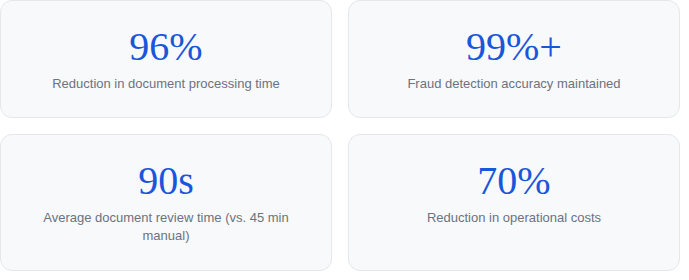
But the real value isn't just speed or cost savings. It's what happens downstream. Loans close faster. Compliance teams focus on genuine risks instead of drowning in manual review. Fraud gets caught on the first attempt, not the fifth. Revenue grows because legitimate customers aren't stuck in verification queues.
✅ The bottom line
When fraud moves at the speed of AI, detection has to move faster. The financial institutions that treat real-time document intelligence as infrastructure — not a nice-to-have — will be the ones still standing when the next wave of AI-powered fraud arrives.
Where Do You Start?
If you're a fraud, risk, or operations leader at a bank, credit union, or fintech, ask yourself three questions:
First: Can your current system detect an AI-generated bank statement? Not a template match — an entirely fabricated document with consistent formatting, realistic data, and no metadata trail?
Second: When you catch a fraudulent document, can you instantly trace it back to related submissions across your portfolio — shared addresses, reused data points, linked identities?
Third: Is your document review happening in seconds — or is it measured in hours and headcount?
If any of those answers give you pause, your detection isn't keeping pace with the threat. And the gap is only widening.
See What Your Current System Misses
Submit a document. See the forensic analysis. Experience real-time document intelligence firsthand.
Sources: FBI Internet Crime Complaint Center (IC3) Annual Reports 2020–2024 · FTC Consumer Sentinel Network Data Book 2024 · Sumsub Identity Fraud Report 2025–2026 · Inscribe AI 2025 Document Fraud Report · Deloitte Center for Financial Services · AllAboutAI Deepfake Statistics 2025